Chapter 3 Query Loop: The Heartbeat of an Agent System
3.1 To judge maturity, first ask whether the system has a loop
Imagining a code-writing model as an upgraded Q&A API is the easiest mistake: once the system starts calling tools, spanning turns, handling interrupts, persisting state, and compacting context, one-shot Q&A collapses. Claude Code structurally admits that agents depend on continuous, stateful execution.
query() at src/query.ts:219 is shell; queryLoop() at src/query.ts:241 is core. It maintains cross-iteration state, performs pre-governance, streams model output, then decides whether to execute tools, recover, compact, continue, or terminate.
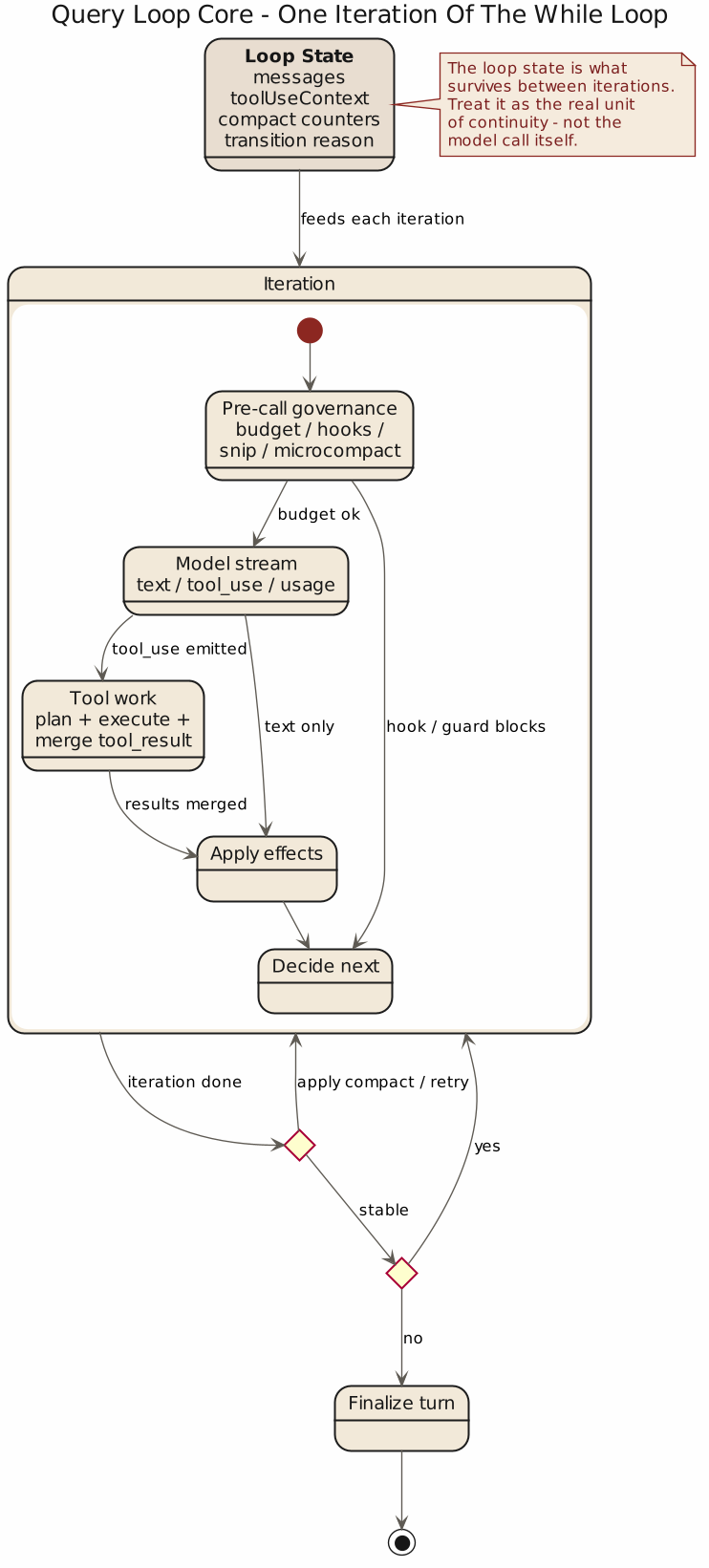
The key word is lifecycle. Whether a system deserves to be called an agent is determined less by how it talks and more by whether it still knows what it is doing several turns later.
3.2 State is core business, not baggage
Many systems initially treat state as a burden and statelessness as elegance. For agent systems this preference has limited value. Once an agent enters real workflows, state emerges naturally. Ignoring state does not remove it; it only makes it return in less manageable form.
Claude Code is explicit here. In src/query.ts:203 to :217, mutable query-loop state is clearly defined:
messagestoolUseContextautoCompactTrackingmaxOutputTokensRecoveryCounthasAttemptedReactiveCompactpendingToolUseSummarystopHookActiveturnCounttransition
At src/query.ts:268, these are assembled into one State object when query loop starts, and updated as a whole through continue branches.
Claude Code does not scatter recovery, compaction, budget, hooks, and turn counting across ad hoc local booleans. Scripts ask only whether this step finished. Agent systems must also ask whether the next step can continue from the state left by a failed step.
Skeleton: queryLoop()
// skeleton: queryLoop()  (src/query.ts:203–1305)
state = { messages, toolUseContext, autoCompactTracking,
          maxOutputTokensRecoveryCount, hasAttemptedReactiveCompact,
          pendingToolUseSummary, stopHookActive, turnCount, transition }

while not done(state):
    govern_input(state)                 // prefetch / snip / microcompact / collapse / autocompact
    events = stream_model(state)
    for e in events:
        if e.is(tool_use):  schedule(e, state.toolUseContext)
        if e.is(api_error): return surface(e)
    if interrupted:
        drain_tools_with_synthetic_results(state); break
    state = advance(state, recover_if_needed(state))

assert state.turnCount_{t+1} >= state.turnCount_t            # state is monotonic
assert every emitted tool_use has a matching tool_result     # ledger is closed
assert hasAttemptedReactiveCompact ⇒ no further compact      # no self-loop
3.3 The first duty of query loop is input governance
From outside, people often assume the core action of an agent is "call the model." In engineering, what matters more is often the long preparation before that call. Claude Code makes this explicit in queryLoop().
Before entering model stage, runtime does all of the following:
- Start memory prefetch, see
src/query.ts:297 - Prefetch skill discovery, see
src/query.ts:323 - Slice valid messages after compact boundary, see
src/query.ts:365 - Apply tool result budget, see
src/query.ts:369 - Perform history snip, see
src/query.ts:396 - Perform microcompact, see
src/query.ts:412 - Perform context collapse, see
src/query.ts:428 - Attempt autocompact last, see
src/query.ts:453
This sequence is an architectural statement by itself. It tells you Claude Code puts context governance before model reasoning. In other words, it does not delegate "turn chaos into order" to the model. Runtime governs first, then passes cleaner inputs to the model.
This is critical because many systems do the opposite: stuff huge context in, then hope the model will decide what matters. That looks convenient but shifts runtime responsibility onto probability distributions.
Claude Code takes a more traditional engineering posture: clean the site first, then execute. It is less elegant, but usually more stable.
3.4 Model invocation is one phase of the loop, not the loop itself
Only after those governance steps does Claude Code enter model invocation, around src/query.ts:652. One detail is worth isolating: output is consumed with for await streaming, not as one synchronous complete response.
That means model output in Claude Code is an event stream, not just final prose. Events may contain:
- assistant text
tool_useblocks- usage updates
- stop reasons
- API errors
This is particularly clear after src/query.ts:826. The system stores assistant messages, extracts tool_use blocks, decides follow-up needs, and can dispatch tools to StreamingToolExecutor while streaming is still in progress.
Engineering-wise, this is a structural shift. Once output becomes event stream, architecture is no longer plain request-response, but a drive-schedule-feedback process. Streaming is not just about seeing words sooner; it lets runtime schedule next actions before model output fully ends.
That is why query loop, not model call, is the heartbeat. Model call is one contraction inside heartbeat. What keeps the system alive is the full cycle: input intake, stream consumption, tool scheduling, failure recovery, and turn continuation.
3.5 A heartbeat must handle interrupts, or it is just inertia
A real heartbeat not only keeps beating, it can also stop when necessary. If it cannot stop, what remains is inertia.
Claude Code handles interrupts very concretely. After src/query.ts:1011, streaming abort is handled first. If streamingToolExecutor is active, remaining results must be consumed and synthetic tool results generated, so issued tool_use blocks are not left without paired results. Otherwise yieldMissingToolResultBlocks() fills missing interruption records.
This follows a basic engineering principle: once the system has committed to execution externally, interruption still requires ledger closure. You cannot pretend earlier tool_use calls never happened just because the user interrupted later. External systems, UI, and transcripts need a consistent causal chain. Even "interrupted" must be complete interruption.
This matters because once an agent enters multi-tool, multi-turn mode, external expectations become more than "did it answer." The system must leave interpretable traces. Non-interpretable traces eventually become operations problems, audit problems, or latent team liabilities no one can explain.
So interrupt handling is core runtime duty. Started actions need closure, even if closure says "not finished."
3.6 A heartbeat must also recover, or it is fragile repetition
If interrupts are external shocks, recovery is internal slack. Loops without recovery capability eventually expose one common flaw: they treated luck as design.
Claude Code's recovery is layered, not simplistic retry. Prompt-too-long and max-output-tokens are typical cases.
After src/query.ts:1065, the system checks whether the last assistant message is a withheld prompt too long. If yes, it first tries to flush staged context collapse (:1086 to :1116); if still insufficient, it enters reactive compact (:1119 to :1166). So recovery proceeds from lower cost and lower destructiveness upward.
max_output_tokens is handled similarly. After src/query.ts:1185, runtime first tries raising token cap; if still insufficient, it appends a meta message telling the model to continue exactly from truncation point, not apologize, recap, or write polite filler.
This reveals Claude Code's design posture. Recovery is part of main runtime path, not post-failure etiquette. Recovery exists to preserve ability to continue work. In real engineering, continuity is usually more valuable than surface polish.
3.7 Stop conditions cannot be singular, or failure and completion get conflated
In ordinary chat systems, stop condition is simple: answer exists, end. Agent systems cannot be this lazy. In one session, "this turn ended" does not equal "task completed," and does not equal "system succeeded."
Claude Code query loop distinguishes at least:
- Streaming completed with
tool_use, requiring follow-up - No
tool_use, entering stop hooks and further checks - User interruption
- Prompt-too-long recovery branch
- Max-output-tokens recovery branch
- Stop-hook blockage requiring loop re-entry
- API errors returning directly
You can see this from src/query.ts:1062 through :1305. The stop-hooks section around :1267 to :1305 is especially important: it explicitly prevents dead loops like "still too long after compact, blocked by hook, compact again forever."
This is worth attention. Many systems have only one naive rule: retry if failed. Claude Code admits retry itself needs governance. Runtime must know why retrying, what already tried, which protection state cannot reset, and what patterns lead to infinity. These decisions separate systems that "keep trying" from systems that "know when not to try again."
Stop-condition failure matrix
| Event order | Pre-state | Trigger | Next |
|---|---|---|---|
stream done + tool_use |
pending tool_use present | stop reason | follow-up, execute tools |
stream done, no tool_use |
no pending tool | stop reason | enter stop hooks |
| user interrupt | any | abort signal | drain remaining results, yield synthetic tool_result |
| prompt_too_long | compact not yet tried | recoverable error | collapse drain / reactive compact |
| max_output_tokens | cap < MAX | stop reason | raise maxOutputTokensOverride, re-run |
| max_output_tokens | cap = MAX | stop reason | append meta user msg, continue writing |
| stop hook block + PTL recurs | hasAttemptedReactiveCompact |
double failure | skip stop hooks, surface error |
| API error | — | api_error | return directly, no retry |
3.8 QueryEngine proves this belongs to conversation lifecycle
If queryLoop() were not enough evidence, QueryEngine makes it explicit.
At src/QueryEngine.ts:176, source states:
QueryEngine owns the query lifecycle and session state for a conversation.
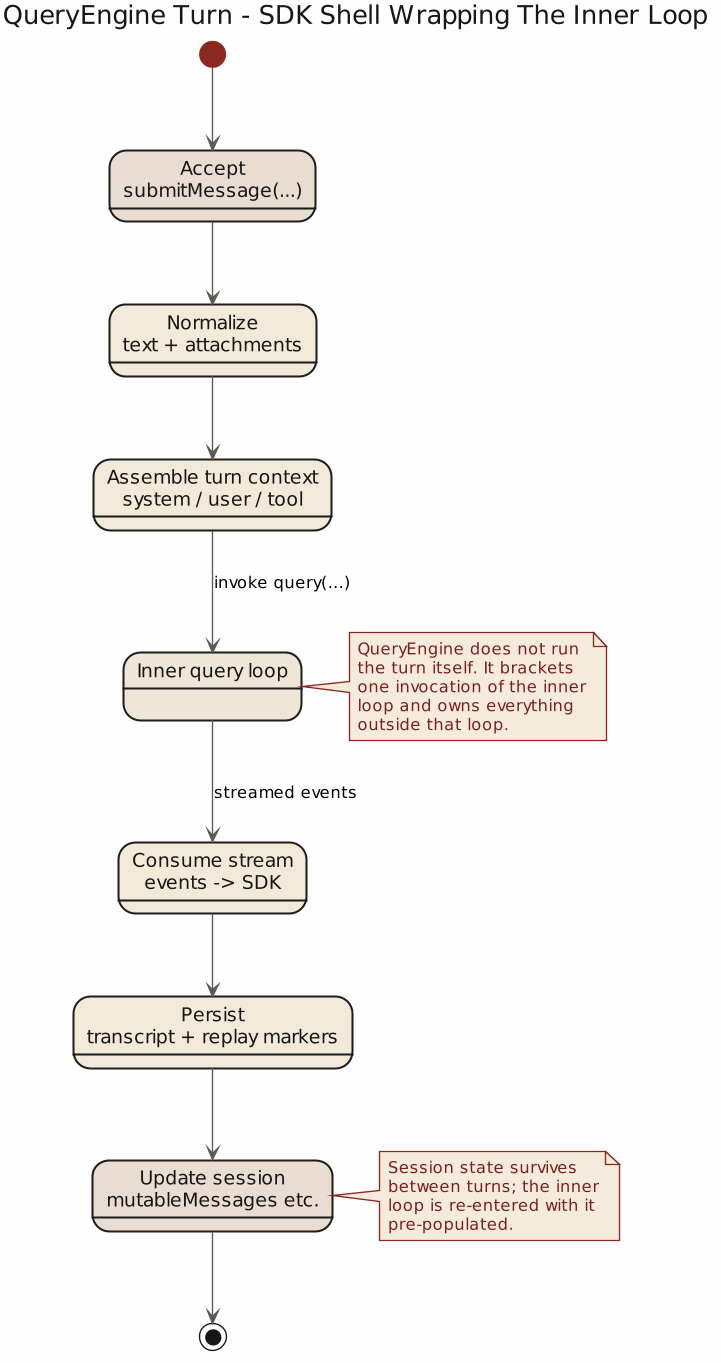
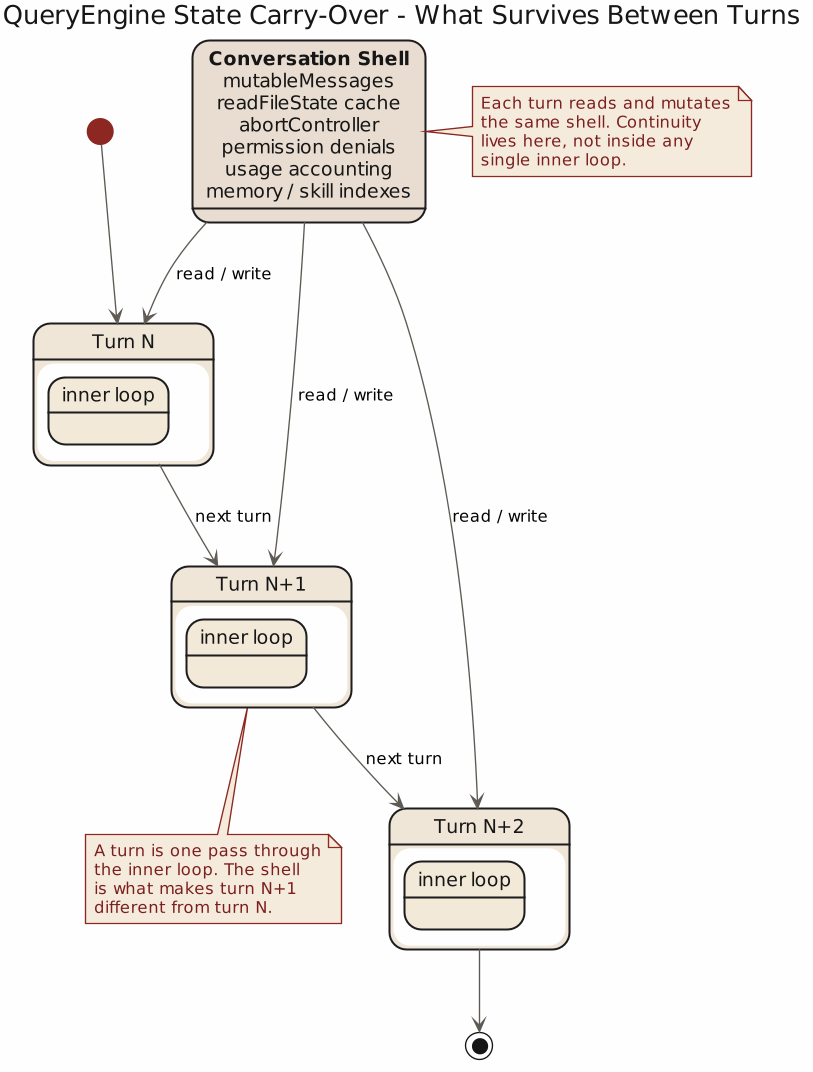
This line states the chapter's point directly. QueryEngine owns conversation lifecycle, not one call. At src/QueryEngine.ts:180, source further states one QueryEngine maps to one conversation, and each submitMessage() opens a new turn inside that conversation while preserving state.
After src/QueryEngine.ts:675, QueryEngine hands prepared messages, systemPrompt, userContext, systemContext, and toolUseContext to query(), then writes assistant/user/compact-boundary messages back into transcript.
This means query loop is the actual execution center of conversation runtime. Outer UI, SDK, and session persistence all orbit it. To understand Claude Code you cannot stop at listing tools or reading prompt text. You must inspect how this loop turns those constraints into continuous behavior.
3.9 The third principle extractable from source
This chapter can be compressed into one line:
The core capability of an agent system is maintaining a recoverable execution loop.
The skeleton, invariants, and stop-condition matrix above already line up the evidence. One line suffices to close: a mature agent heartbeat must simultaneously govern cross-turn state, input governance, streaming consumption, the interrupt ledger, and the distinction between {completion, failure, recovery, continuation}.
Without these structures, systems may still produce attractive demos, but they are closer to staged performances than runtimes. Performances have value, but they do not replace order.
Next chapter moves to where heartbeat most directly touches the external world: tools, permissions, and interrupts. This chapter explained why loops exist. Next we explain why once loops own tools, they must also learn restraint.