Chapter 2: Two control planes—dynamic prompt layers vs structured fragments
2.1 Control is not about tone
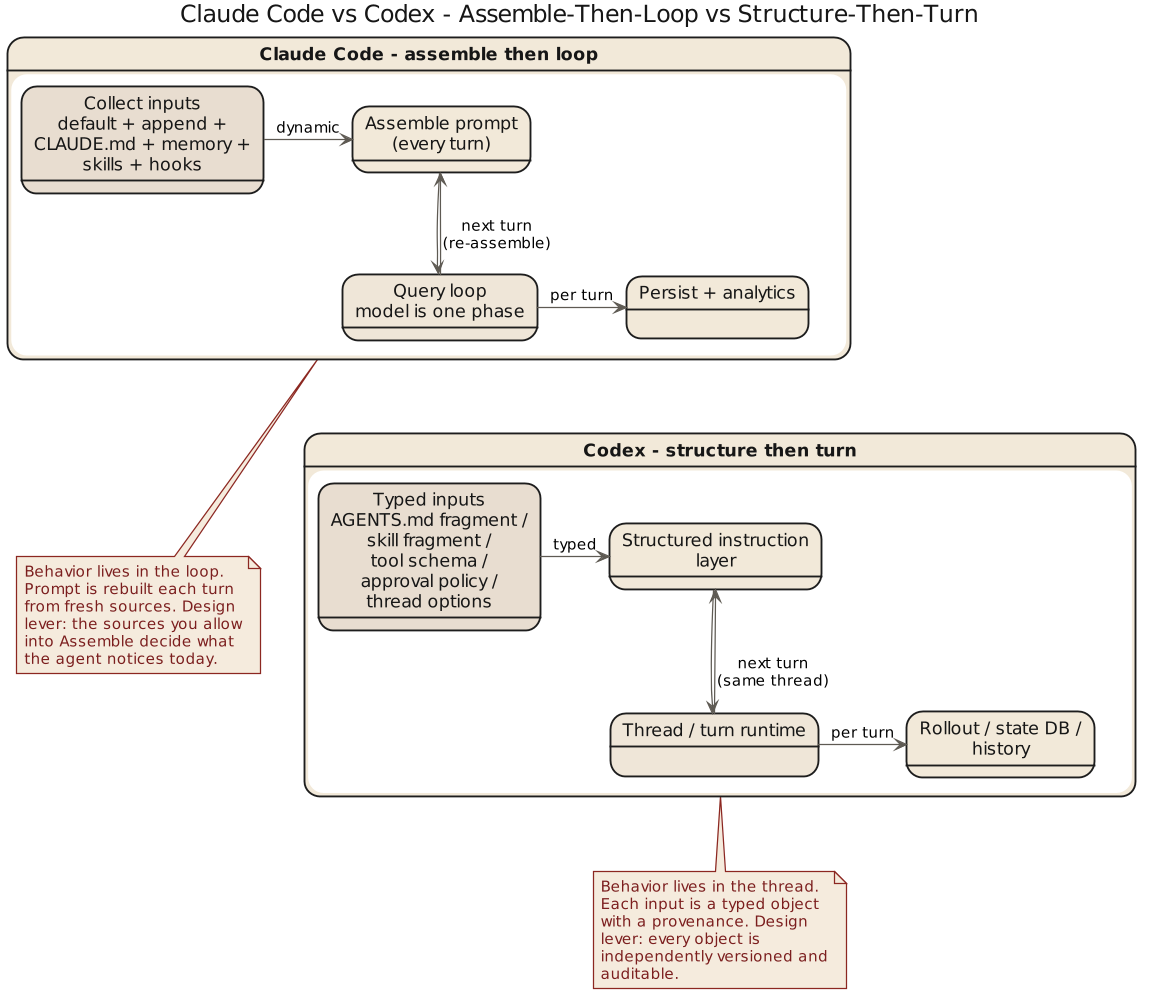
Treating prompts as a tone exercise is misleading. Claude Code and Codex both treat prompts as part of a behavioral control plane; the difference is in the mechanism that assembles them. Claude Code assembles dynamically — baseline text, append prompts, agent roles, CLAUDE.md, memory, and output styles layered at runtime according to task, tools, and team context; the art is priority, conflict resolution, and how each layer folds into the next. Codex treats instructions as structured fragments — AGENTS.md, user messages, and skills become chunks with clear markers, start/end boundaries, and serialization rules, turning instructions from free-form narrative into identifiable contextual units.
2.2 Claude Code's busy assembly line
System prompts here are not fixed documents but a production line: defaults form the foundation, append prompts drop requirements, agent prompts add roles, CLAUDE.md and memory inject local conditions. Flexibility lets one loop handle many scenarios, but ordering is critical — wrong ordering dilutes instructions or lets conflicts slip through. Runtime governance is therefore essential: control is constantly injected, overwritten, compressed, or pruned as tasks shift, and the loop recalculates "what matters now" each round. The guiding intuition: control follows the scene — it cannot freeze into static rules.
2.3 Codex's filing-room approach
Codex insists on identifiable fragments. Names like ContextualUserFragmentDefinition highlight type, boundaries, wrapping rules, and message transformation. AGENTS, skills, and user instructions are tagged contextual units the system can recognize and manipulate — stronger debuggability, and a path to more programmatic governance because every instruction already fits a type hierarchy.
And this is not merely elegant naming. fragment.rs defines constants like AGENTS_MD_START_MARKER, AGENTS_MD_END_MARKER, SKILL_OPEN_TAG, and SKILL_CLOSE_TAG; ContextualUserFragmentDefinition::wrap() and into_message() turn those fragments into ResponseItem::Message. In user_instructions.rs, UserInstructions serializes the directory into # AGENTS.md instructions for ..., while SkillInstructions carries explicit <name> and <path> fields. Codex tries hard not to make the model guess where a rule came from.
Skeleton: two control-plane assemblies
// skeleton: Claude Code dynamic assembly  (src: constants/prompts.ts, utils/systemPrompt.ts, claudemd.ts)
system_prompt = concat(
    default_prompt,           // baseline
    append_prompt,            // overlay requirements
    agent_prompt,             // role
    claudemd_layers,          // team / personal / project
    memory_sections,          // session memory
    output_style              // expression discipline
)
// recomputed every loop: memory prefetch, collapse, microcompact, autocompact

// skeleton: Codex fragment assembly  (src: instructions/src/fragment.rs, user_instructions.rs)
for frag in [agents_md, skill, user_instructions]:
    body = ContextualUserFragmentDefinition::wrap(
        START_MARKER, content, END_MARKER,
        meta { source_dir, name, path }
    )
    msg  = frag.into_message()              // -> ResponseItem::Message
    thread.append(msg)
Invariants
assert every fragment has matching (START_MARKER, END_MARKER)   # markers paired
assert fragment.source ∈ {AGENTS_MD, SKILL, USER}              # type is identifiable
assert precedence(project) > precedence(team) > precedence(default)  # monotonic priority
assert claudemd_layers overlay order = team → personal → project  # later overrides earlier
assert child_agents_md enabled ⇒ append scope/precedence notes  # scope is explicit
2.4 CLAUDE.md vs AGENTS.md
CLAUDE.md is a local bulletin board: close to the task directory, paired with memory and skills, good for registering common sense, taboos, and local rules. AGENTS.md is pulled into Codex's hierarchy discussion — docs/agents_md.md says that even when no AGENTS.md is present, enabling child_agents_md appends scope and precedence notes. Codex cares not just whether rules exist, but whether their applicability and inheritance are explicitly stated. Claude Code brings local rules into the conversation; Codex brings them into the institution.
2.5 The trade-offs
Runtime assembly is flexible but hard to formalize, leaning on the main loop and engineering judgment; once rules multiply, overlap and semantic dilution become real risks. Structured fragments are explicit but heavier: markers, types, serialization, and injection all need definitions, plus calls on what deserves first-class status. The former grows experience-driven control, the latter grows institutional control — one agile but under-declared, the other clear but carrying ongoing structural cost.
2.6 This chapter's conclusion
Claude Code views prompts as dynamic runtime builds; Codex views instructions as identifiable fragments.
One feels like a production floor, the other like a bureaucracy. The right choice depends on whether your primary worry is volatile sessions or unclear rule sources. The next chapter goes deeper: does continuity live in the query loop, or in thread, rollout, and state infrastructure?